


Quick Summary: Learn how to hem straight jeans with baking soda for a quick, no-sew, and surprisingly effective solution. This method offers a temporary, budget-friendly way to adjust jean length using common household items, perfect for trying out new styles or for emergencies.
How to Hem Straight Jeans: Essential Baking Soda Secrets
Have you ever brought home a fantastic pair of straight jeans, only to realize they’re just a smidge too long? It’s a common frustration! Dragging denim can snag, look sloppy, and even present a tripping hazard. But the thought of tackling a sewing project can feel daunting, especially if you’re new to DIY fashion fixes. What if there was a super simple, no-sew trick using something you probably already have in your kitchen? Get ready, because we’re about to unlock the easy secret to hemming straight jeans using baking soda, a method so straightforward, you’ll wonder why you didn’t try it sooner.
This method is perfect for those moments when you need a quick fix, want to experiment with a new hem length, or simply prefer to avoid needles and thread. We’ll guide you through each step, making the process clear, achievable, and even a little fun. Stick around, and you’ll soon have perfectly proportioned jeans ready to wear.
Why Use Baking Soda to Hem Jeans?

The idea of using baking soda for hemming might sound unusual, but it’s a clever hack that plays on its mild abrasive and absorbent properties. When combined with water and heat, baking soda can create a temporary stiffening agent that helps hold fabric in place. This is particularly useful for denim, which can be stubborn to fold and hold a crease. Think of it as a gentle, temporary “glue” made from pantry staples.
This method is not about permanent tailoring; it’s about practicality and accessibility. It’s an excellent alternative when:
- You need an immediate solution for jeans that are too long.
- You want to test a new cropped length before committing to a permanent hem.
- You’re traveling and need to adjust your clothing on the go.
- You’re looking for a budget-friendly way to alter your jeans without purchasing special tools or paying for alterations.
- You prefer a no-sew approach that’s gentle on your fabric.
The Baking Soda Hemming Toolkit

Before we dive into the steps, let’s gather what you’ll need. The beauty of this method is its simplicity; you likely have most of these items already.
Essential Items:
- Your Straight Jeans: The star of the show! Make sure they are clean.
- Baking Soda: Your primary “secret” ingredient.
- Water: Just a small amount.
- A Small Bowl: For mixing the baking soda paste.
- A Spoon or Stirrer: To mix the paste.
- An Iron: A standard household iron is perfect.
- An Ironing Board: For a stable surface.
- Scissors (Optional but Recommended): For trimming excess fabric if desired.
- Measuring Tape or Ruler: To ensure an even hem.
- Fabric Chalk or a Pencil: To mark your desired hemline.
- A Damp Cloth: For pressing and setting.
Step-by-Step: The Baking Soda Hemming Process

Ready to transform your jeans? Follow these easy steps for a quick and effective hem. Remember, this is a temporary fix, great for immediate needs or experimenting.
Step 1: Prepare and Measure
First, try on your jeans and decide on the desired length. Pin or mark where you want the new hem to fall. Use a measuring tape or ruler to ensure the mark is even all the way around. It’s always better to start a little longer; you can always trim more if needed.
Pro Tip: Wear the shoes you typically wear with these jeans when measuring. This ensures the hem length looks perfect with your intended footwear.
Step 2: Mark Your Hemline
Once you’ve decided on the length, take off the jeans and lay them flat. Use your fabric chalk or pencil to draw a clear line marking where you want the new hem to sit. If you’re aiming for a raw hem look, you might mark where you want the fabric to be cut. If you want a clean fold, mark it where the folded edge will lie.
Step 3: Create the Baking Soda Paste
In your small bowl, mix about 2-3 tablespoons of baking soda with just enough water to create a thick paste. You want a consistency similar to toothpaste – not too runny, not too dry. Mix it thoroughly with your spoon until smooth.
This paste will act as a mild stiffener and adhesive when heated.
Step 4: Apply the Paste (Option 1: Folded Hem)
If you’re creating a folded hem, fold the excess fabric up to your marked hemline. You can create a double fold for a cleaner finish (fold the raw edge under once, then fold again to your marked line). Press the fold with your hands.
Now, carefully apply the baking soda paste along the inside edge of the fold. Use your finger or the back of the spoon to spread a thin, even layer. Don’t saturate the fabric; just a light coating is needed.
Note: This paste creates a temporary bond. It’s not a permanent seam.
Step 5: Apply the Paste (Option 2: Raw Hem)
If you’re going for a raw hem, you’ll likely cut off the excess fabric below your marked line first. Then, apply a thin layer of the baking soda paste along the very bottom edge of the remaining fabric where the original hem was. This helps to slightly stiffen the edge and can minimize fraying if you’re looking for a very controlled raw look. For a more traditional raw hem that will fray naturally, you might skip the paste entirely or use it very sparingly.
Step 6: Fold and Press
Once the paste is applied (for a folded hem), neatly fold the fabric up to your marked hemline. If you did a double fold, ensure the raw edge is tucked inside. Press down firmly with your hands to create a crisp crease over the paste-applied area.
Lay the jean leg flat on your ironing board, ensuring the hem is perfectly aligned.
Step 7: Ironing and Setting
Set your iron to a medium-high heat setting, appropriate for denim. Crucially, ensure the steam function is OFF. You want dry heat to activate the baking soda paste.
Place a damp cloth over the hemmed area. Then, press the hot iron firmly onto the damp cloth for about 15-30 seconds. Move the iron around slightly to ensure even heat distribution over the entire hemmed section. The heat and moisture from the damp cloth will react with the baking soda, helping to set the fold.
Repeat this pressing process several times, lifting the iron and allowing the fabric to cool slightly between presses. This repeated heat and pressure helps to strengthen the temporary hold.
Step 8: Cooling and Testing
Let the hemmed section cool completely. This is important for the bond to set properly. Once cool, gently unfold and check the hold. The baking soda and heat should have created a surprisingly firm crease.
You can then try on your jeans to see how they look. Give the hem a gentle tug to test its strength. If it feels secure enough for your needs, you’re done!
Step 9: Finishing Touches (Optional)
If you achieved a clean folded hem but want a little extra security, you have a few no-sew options:
- Fabric Glue: Apply a thin line of fabric glue along the inside of the folded hem.
- Hem Tape: Use iron-on hem tape for a more robust, semi-permanent no-sew hem. You’ll need to follow the tape’s specific instructions, which usually involve ironing.
- Stitching: If you decide you like the length but want a permanent fix, you can later sew the hem traditionally.
If you opted for a raw hem and applied paste, you might find it holds its position better. For a more authentic frayed look, you can gently pull at the threads on the cut edge after a few wears or wash cycles.
Pros and Cons of the Baking Soda Hemming Method

Like any DIY hack, this method has its advantages and disadvantages. Understanding these will help you decide if it’s the right technique for your situation.
Pros:
| Advantage | Description |
|---|---|
| Speed and Convenience | Extremely fast and can be done in minutes with common household items. |
| No Sewing Required | Perfect for those who lack sewing skills or tools. |
| Budget-Friendly | Uses inexpensive ingredients already in your pantry. |
| Temporary and Experimental | Ideal for trying out different lengths without commitment. |
| Accessible Tools | Requires only basic items like an iron and baking soda. |
Cons:
| Disadvantage | Description |
|---|---|
| Temporary Hold | The hem may not be as durable as a sewn hem and can come undone with heavy wear or washing. |
| Not Waterproof | Water can weaken the baking soda bond; avoid this method if your jeans might get wet frequently. |
| Potential for Residue | While usually washable, there’s a small chance of a faint residue if not applied or ironed correctly. |
| Limited Style Options | Best for simple, folded hems or basic raw hems. Complex hemming styles aren’t suitable. |
| Fabric Dependent | Works best on denim and similar sturdy fabrics. Might not be effective on very lightweight or slippery materials. |
Comparing Hemming Methods
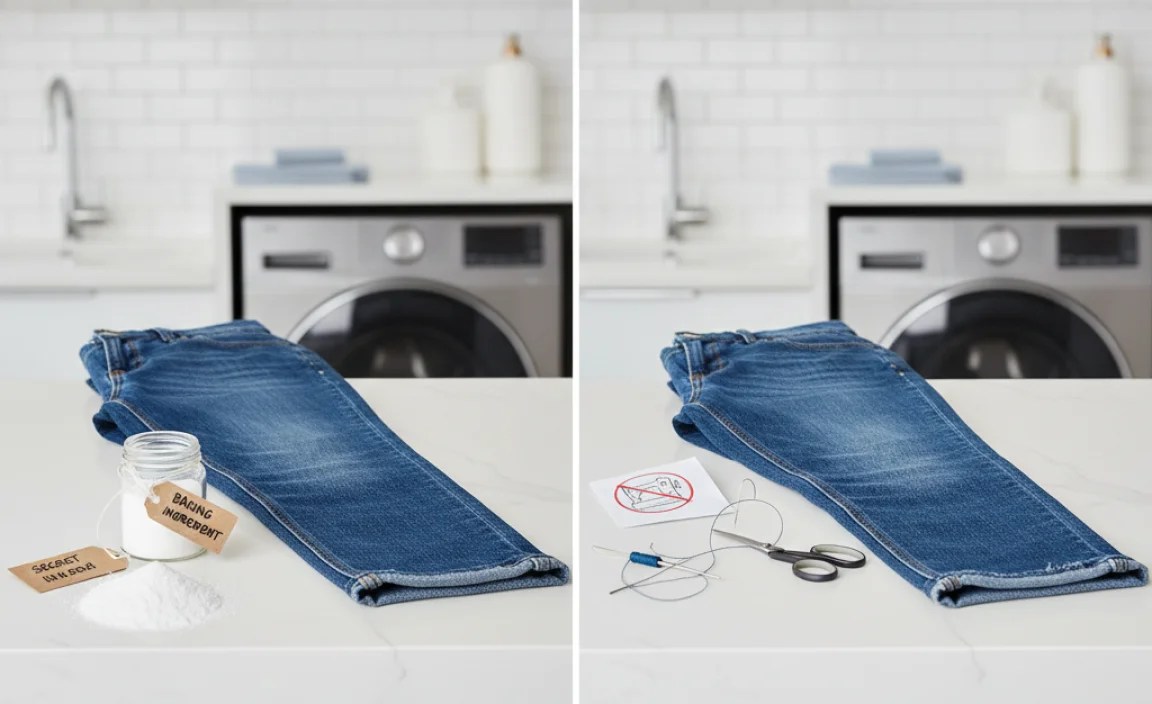
To further understand the baking soda trick, let’s compare it to other common hemming methods. This helps establish its place in your DIY wardrobe arsenal.
| Method | Ease of Use | Durability | Time Commitment | Cost | Best For |
|---|---|---|---|---|---|
| Baking Soda Hem | Very Easy | Temporary | Minutes | Very Low | Quick fixes, experimentation |
| Sewing a Hem (Hand/Machine) | Moderate to Difficult | Permanent and Durable | 1-2 Hours | Low (sewing supplies) to High (tailor) | Permanent alterations, all styles |
| Fabric Glue/Tape | Easy | Semi-Permanent to Durable | 15-30 Minutes | Low to Moderate | No-sew permanent hems, quick fixes |
| Cutting a Raw Hem | Easy | Variable (frays over time) | Minutes | Free | Casual/distressed look |
As you can see, the baking soda method fills a unique niche for quick, temporary adjustments. For more lasting results, especially for everyday wear, sewing or using dedicated fabric adhesives like wash-away stabilizers (often used in embroidery but can help mark and stabilize fabric edges for cutting) or strong fabric glue might be more appropriate.
Tips for Perfecting Your Hem
Even with a simple method, a few tips can elevate your results. Here’s how to get the best possible outcome when hemming your straight jeans with baking soda:
- Always Start Long: You can always cut more fabric off, but you can’t add it back. Measure twice, cut once (or in this case, fold once!).
- Even Application: Ensure the baking soda paste is spread evenly. Patches of thick or thin paste can lead to uneven holding.
- Dry Heat is Key: Make absolutely sure your iron’s steam setting is OFF. Dry heat is what activates the baking soda effectively.
- Use a Damp Cloth: The damp cloth transfers moisture and heat while protecting the denim from direct iron contact, preventing scorching and helping the paste to set.
- Press and Cool: Multiple pressing cycles with cooling periods in between will yield better results than one quick press.
- Consider the Fabric Weight: This method works best on traditional denim. Very thin or very thick denim might react slightly differently.
- Test on Scrap Fabric: If you’re really unsure, try the process on a piece of scrap fabric first to get a feel for it.
Frequently Asked Questions About Baking Soda Hemming
Q1: How long will a baking soda hem last?
A1: The hold is temporary. It can last for a few wears or a quick event, but it’s not designed for long-term wear or regular washing. Water and repeated stress will weaken the bond.
Q2: Can I wash my jeans after hemming with baking soda?
A2: It’s best to avoid washing immediately. If you must wash them, use a gentle cycle with cold water and expect the hem to loosen. For best results with this method, treat the hem as a temporary fix.
Q3: Will baking soda damage my jeans?
A3: Generally, no. Baking soda is a mild alkali. When used as a paste and heated with a damp cloth, it’s unlikely to cause permanent damage. However, always test on an inconspicuous area if you’re concerned about fabric sensitivity.
Q4: What if the hem doesn’t hold?
A4: This can happen if the paste was too thin, the heat wasn’t sufficient, or the fabric wasn’t pressed long enough. Try reapplying the paste and pressing again, ensuring adequate heat and time. For a more secure hold, consider fabric glue or hemming tape.
Q5: Can I use this method on other fabrics?
A5: It works best on sturdy fabrics like denim or canvas. For delicate fabrics like silk or rayon, it’s not recommended. Always test on a scrap piece first.
Q6: How do I remove the baking soda hem?
A6: Simply wash the jeans as you normally would. The baking soda bond will dissolve in water, and the hem will fall back to its original length or require re-folding.
Conclusion
You’ve successfully learned how to hem straight jeans using the surprisingly effective baking soda method! This technique offers a fantastic, no-sew solution for those quick adjustments and style experiments. Whether you need to shorten your jeans for a specific occasion, test out a new trend, or simply find yourself in a pinch, this pantry staple trick comes to the rescue. Remember, its magic lies in its speed and simplicity, making it an accessible tool for anyone. While it’s not a permanent tailoring solution, it empowers you to customize your wardrobe quickly and affordably.
So, the next time your favorite straight jeans are just a little too long, you know exactly what to do. Grab that baking soda, your iron, and a few minutes, and achieve a perfectly hemmed look. With these secrets shared, you’re well-equipped to handle common denim dilemmas with confidence and ease. Happy hemming!
.lwrp.link-whisper-related-posts{
margin-top: 40px;
margin-bottom: 30px;
}
.lwrp .lwrp-title{
}.lwrp .lwrp-description{
}
.lwrp .lwrp-list-container{
}
.lwrp .lwrp-list-multi-container{
display: flex;
}
.lwrp .lwrp-list-double{
width: 48%;
}
.lwrp .lwrp-list-triple{
width: 32%;
}
.lwrp .lwrp-list-row-container{
display: flex;
justify-content: space-between;
}
.lwrp .lwrp-list-row-container .lwrp-list-item{
width: calc(25% – 20px);
}
.lwrp .lwrp-list-item:not(.lwrp-no-posts-message-item){
max-width: 150px;
}
.lwrp .lwrp-list-item img{
max-width: 100%;
height: auto;
object-fit: cover;
aspect-ratio: 1 / 1;
}
.lwrp .lwrp-list-item.lwrp-empty-list-item{
background: initial !important;
}
.lwrp .lwrp-list-item .lwrp-list-link .lwrp-list-link-title-text,
.lwrp .lwrp-list-item .lwrp-list-no-posts-message{
}@media screen and (max-width: 480px) {
.lwrp.link-whisper-related-posts{
}
.lwrp .lwrp-title{
}.lwrp .lwrp-description{
}
.lwrp .lwrp-list-multi-container{
flex-direction: column;
}
.lwrp .lwrp-list-multi-container ul.lwrp-list{
margin-top: 0px;
margin-bottom: 0px;
padding-top: 0px;
padding-bottom: 0px;
}
.lwrp .lwrp-list-double,
.lwrp .lwrp-list-triple{
width: 100%;
}
.lwrp .lwrp-list-row-container{
justify-content: initial;
flex-direction: column;
}
.lwrp .lwrp-list-row-container .lwrp-list-item{
width: 100%;
}
.lwrp .lwrp-list-item:not(.lwrp-no-posts-message-item){
max-width: initial;
}
.lwrp .lwrp-list-item .lwrp-list-link .lwrp-list-link-title-text,
.lwrp .lwrp-list-item .lwrp-list-no-posts-message{
};
}


